Kineret Haya Max is a Performance-Art artist
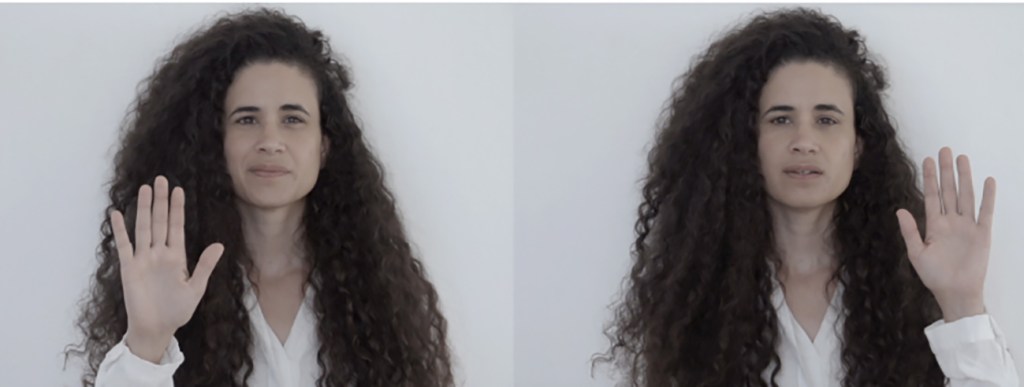
Her works, although very physically engaging and often feisty, attempts to go beyond the presence of the body or the expression of the self. Instead, they introduce performance as a process, as a junction of actions and interactions within a public situation. She often uses the body, presence and the poetics of the encounter between the artist and the audience as an artwork that has the potential to stands for itself.
Artist Statement
I see myself as a translator or a transmitter, echoing in my works ideas that already exist in the world outside. I may be hunting them; I may be a conduit for them. When the work is finally delivered, it comes to an essence so simple that I feel that I’m doing what “goes without saying,” and it is my honor to be the loyal servant of the obvious. I use the body, my voice, and the poetics of the image to present these particles. I take all that hurts and everything beautiful seriously and wish to be a channel and a gaze for them. For me, they hold a trace of the place from which the act of art stems from.
I have a strong relationship with language – it carries the basis for shared knowledge. I move between verbal and visual language, speak through images, and treat images as concepts. We translate every manifestation in the world into a language. It is an instinct rooted in ancient cultural ideas. When something is so profoundly rooted while containing compressed knowledge, it indicates that at least one more parallel dimension exists in the invisible regions. That’s where poetry lives.
As a performance art artist, the “I,” the present body, is the central material in my works. I use it in interwind layers: the first is the “I AM,” which reflects the components of my identity, such as – a woman, Israeli, Jewish, Levantinian, a mother, etc. – these are all active materials. The second layer lies in the similarity between the phonetics sound of “I” and “eye” – hence, I am occupied in what I see, and as a result, what asks to be seen comes out. When we observe closely in the eyes of our times, we see something wider than ourselves. The third “I” is the universal vocal reaction to pain – AYA, indicating how art can transcend pain into beauty.
My practice seeks to generate motion and create space, which derives from the same root in the Hebrew language (Chalal and Lecholel). There is no vacuum; one will always meet a place – the ever-lasting context and content. Time is also a place. A period likewise. Every place I refer to in my works is positioned within a broader place. When I arrive at a place, I know it will speak if I keep quiet – this will always be my first act within a work process.
Full CV
 Kineret Haya Max